
Strength training does not need to be complicated to be effective. In fact, the simpler and more repeatable your structure is, the more likely you are to train consistently and actually get stronger over time.
This post explains how I set up a strength workout using movement patterns, how I choose exercises, and how rep ranges change the training effect. That is the purpose. No fluff, no endless variations.
A Quick Note on My Own Training
For context, strength training is the foundation of my week and I train strength three times a week. Alongside that, I usually run a relaxed 5 km once a week and do a short Pilates or yoga session over the weekend. Those sessions support my strength work, but they do not replace it.
This post, however, is about how to structure a strength session, not my entire routine.
Train by Movement Pattern, Not Muscle Group
When I design a strength workout, I organise it by movement pattern rather than individual muscles.
Movement patterns reflect how the body actually works in real life. When you train them consistently, you automatically cover all major muscle groups in a balanced and functional way.
A complete strength workout includes:
- Squat
- Hinge
- Unilateral leg (lunge pattern)
- Upper body push
- Upper body pull
- Carry or hang
That is the framework. Everything else is just exercise selection.
How I Choose Exercises
For each movement pattern, I pick one exercise.
Squat
Goblet squat
Front squat
Box squat
Hinge
Deadlift
Romanian deadlift
Kettlebell hinge
Unilateral or Lunge
Reverse lunge
Step-ups
Rear-foot elevated split squat
Upper Body Push
Push-ups
Chest press
Overhead press
Upper Body Pull
Bent-over row
One-arm row
Lat pull-down
Carry or Hang
Farmer’s carry
Suitcase carry
Dead hang
I do not try to hit every variation in one session. I would rather repeat movements, get stronger at them, and progress gradually over time.
Sets, Reps, and What They Do
Once the structure is in place, the rep range determines what you are training.
Here is the simple breakdown:
5 to 8 reps
Heavier loads with more rest
Primary focus: strength
8 to 12 reps
Moderate to heavy loads
Primary focus: muscle strength and size
This is the range I use most often
12 to 20 or more reps
Lighter loads with shorter rest
Primary focus: muscular endurance, joint tolerance, and metabolic work
Regardless of the rep range, the key principle stays the same.
The set should feel challenging by the end.
If you finish a set knowing you could easily do several more reps, the stimulus is likely too light.
Putting It All Together
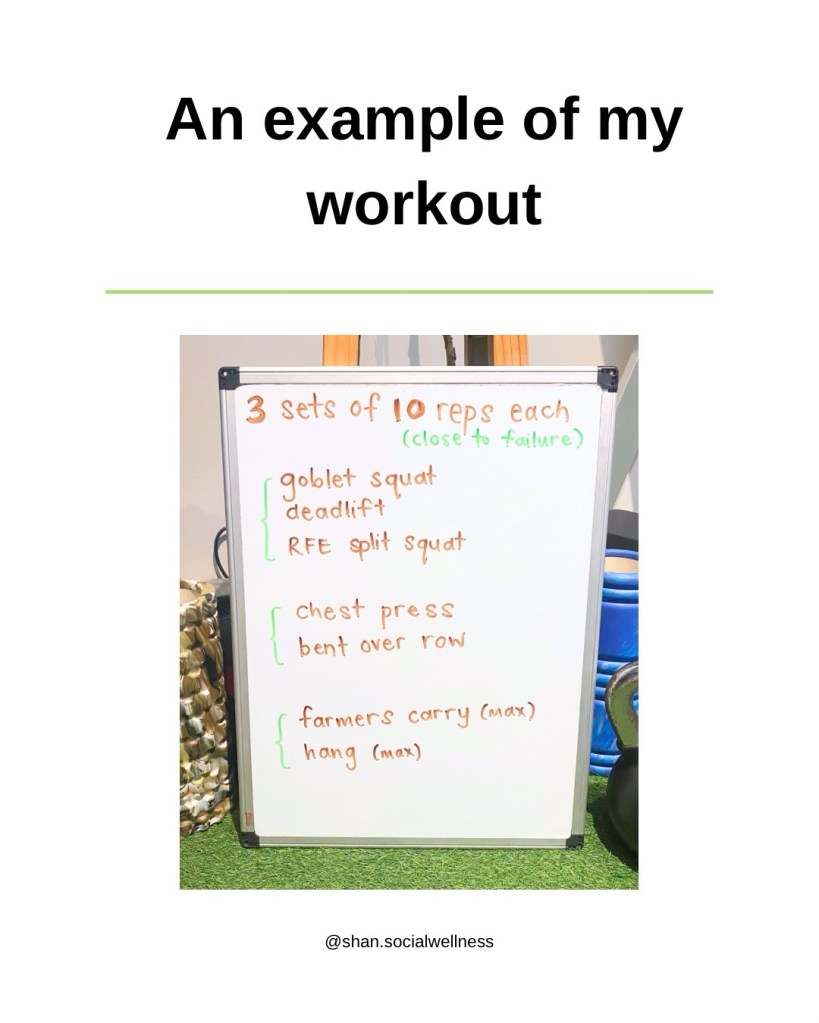
A simple strength workout might look like this:
- Squat: 3 sets
- Hinge: 3 sets
- Unilateral leg: 3 sets
- Push: 3 sets
- Pull: 3 sets
- Carry or hang: 2 to 3 rounds
You can adjust reps, load, or rest depending on whether the goal is strength, muscle gain, or general fitness, but the structure stays the same.
This consistency is what allows progress without constantly reinventing your workouts.
Why This Works
This approach works because it is:
- Balanced
- Repeatable
- Easy to scale up or down
- Grounded in how the body actually moves
You do not need more exercises. You need a clear structure, appropriate effort, and enough repetition over time for your body to adapt.
That is how I set up my strength workouts, and how I encourage others to do the same.
 Social Wellness
Leave a comment